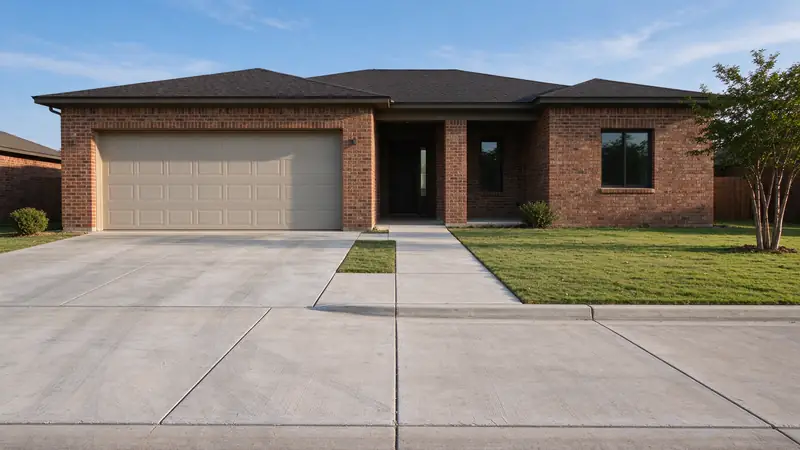
Cibolo publishes concrete flatwork requirements specific enough to influence how a driveway replacement is planned. The standards address pre-pour inspection, minimum concrete thickness, apron details and joints. This is a useful distinction for an owner comparing a simple crack repair with a full reconstruction.
The apron and interior slab are not always the same section
The city’s published flatwork details include a minimum five-and-a-half-inch driveway apron thickness at the curb in the cited guidance, while ordinary slab requirements are described separately. An owner should not assume that the portion near the street can be poured to the same unverified section as an interior panel. The city also specifies inspection before concrete placement. The practical sequence is to establish the regulated footprint, show how the new apron meets the curb and sidewalk, verify the required section and inspection, then schedule placement. Finished grades should carry water away without creating a sharp vehicle transition.
Why joint details matter during replacement
A joint at the garage or between driveway panels accommodates movement differently from an uncontrolled crack. If a replacement slab is poured against an existing structure without proper separation, new cracking can occur in the fresh work. Cibolo’s published standards include joint details, so a quote should describe how those will be followed. A narrow joint repair may be sufficient when filler has deteriorated and the slab is otherwise sound. If one edge has lost support, however, filling the separation does not make the base stable again. The cause of the height difference should be examined before choosing the small repair.
Concrete strength figures are not a complete design
The city’s flatwork requirements include a cited 2,500 psi concrete strength level and minimum slab dimensions for specified applications. Those numbers should be checked against the current adopted details and the actual loading before construction. They do not excuse poor subgrade compaction, inadequate drainage or incorrect finish elevations. A thicker slab may still crack or sink when water undermines its support. A useful estimate identifies base work, reinforcement where required, joints and the intended loads rather than advertising only a nominal concrete strength number. Never infer that a particular existing slab fails the city standard without seeing its actual construction.
When to consider a smaller Cibolo repair
Surface scaling, an isolated edge chip or a stable narrow crack may be repaired without removing all the surrounding concrete when the remaining material is sound. A settled intact panel could be assessed for lifting. Wide displacement, fractured corners or repeated failures can shift the recommendation toward removal and rebuilding support. An owner comparing alternatives should ask which condition the method addresses and how the finished surface will drain. If the project touches the city-regulated approach or includes new concrete placement, verify the current application and inspection requirements before booking the crew.
Cibolo driveway questions
Does Cibolo inspect concrete before a pour?
Its published flatwork guidance includes a pre-pour inspection step. Confirm the required inspection for the scope the city approved.
Can I use a uniform slab thickness everywhere?
Not without verifying the standards and loading. The city distinguishes apron details at the curb.
Will joint sealant fix a settled panel?
No. Joint sealant helps manage a gap; a change in slab support must be evaluated separately.
Additional planning considerations
A driveway quote might specify a standard slab thickness without distinguishing the curb approach. Cibolo’s published flatwork details are a good reminder to verify which parts of the new concrete must follow which section. The contractor should confirm where the regulated apron starts, where the existing curb and sidewalk lie, and how the project will remain accessible for inspection before concrete placement. The owner can then compare bids for equivalent materials and preparation. A simple price per square foot that omits the thicker approach, joints or inspection sequence may not be comparable to one that includes them.
A surface crack running through an existing control joint may only require joint treatment when the adjacent panels remain stable. A jagged fracture that crosses an unsupported corner tells a different story. Those symptoms should be photographed from different angles and compared with the full driveway grade. A measured offset matters more than whether the concrete is old or new. If replacement is selected, finished slopes, joint layout and base preparation should be set before pouring. A repair chosen solely for its neat visual finish can leave the movement condition untouched.
A scope check before scheduling
A property owner comparing quotes can ask the contractor to show the concrete section proposed at both the interior driveway and the street apron. This helps reveal a quote that lists only one uniform slab thickness where the city distinguishes construction details. The crew should plan for the required pre-pour review rather than treating the inspection as paperwork that can be handled afterward. Work areas also need sufficient space for delivery, finishing and protection while concrete cures. If only a limited patch is needed, the quote should explain the sound concrete left in place and why it can support the new repair.
Related services and local references
Concrete driveway repair · Asphalt driveway repair · Driveway replacement · Driveway drainage · Service areas.
Elm Driveway Repair San Antonio coordinates driveway and pavement service in the service area with work performed by appropriately licensed and insured contractors. The condition must be evaluated before choosing a repair technique or making a scheduling commitment. For a property-specific proposal, send the surface description and photos.
Official starting points: