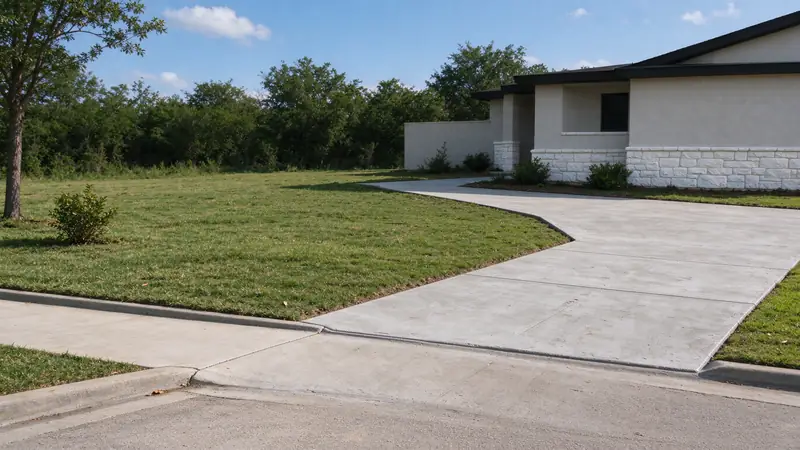
Elm Driveway Repair San Antonio offers concrete driveway repair, driveway leveling, replacement, asphalt work, and commercial paving services for qualifying projects in Schertz, Texas. A Schertz driveway project requires attention to two things at once: the actual condition of the pavement and the city's specific flatwork approval process. A low slab, fractured joint, or new parking pad is not automatically the same kind of work, even if all three involve concrete.
What makes a Schertz driveway project different?
Schertz publishes a residential concrete flatwork process that includes driveways, sidewalk work, driveway approaches, and parking surfaces. New flatwork applications can require a building permit application, a site survey showing easements and property lines, and plans identifying the proposed concrete and its supporting materials. The city's guidance also calls for pre-pour and final inspections. This matters when planning a new approach, driveway extension, or reconstructed section because site drawings and inspection access may affect how the work is sequenced. Visit the official Schertz building permits page and inspection guidance for the applicable process.
Not every small repair automatically triggers the same submittal as new concrete installation. A surface crack that can be sealed without removing pavement is a different operation from pouring a widened apron or new pad. The appropriate first step is to describe the actual scope and confirm what Schertz requires for that address. An estimate that simply assumes San Antonio city permits apply in Schertz would miss the local distinction.
A cracked panel does not always mean a replacement driveway
Driveway cracks range from fine surface openings to fractures with an obvious difference in height between the two sides. The distinction matters because sealing a stable crack and rebuilding a moving slab solve different problems. If the slab remains sound, the joint system is functional and drainage is acceptable, a localized repair may be sensible. If several panels have broken, the base is soft, or water is undermining an edge, repairability becomes a larger question.
A typical comparison weighs the extent of damage, expected loads, condition of adjacent panels and how repaired sections will meet existing grades. Where the driveway connects to a sidewalk or approach, the edge details can be just as important as the center of the slab. A new pour that creates an abrupt height change at a public walkway would be a poor result even if the concrete itself looked smooth.
Driveway crack and joint repair
Small, stable cracks may be prepared and filled with an appropriate material after debris and unsound surfaces are removed. Failed expansion-joint filler can allow debris and water into the opening. Joint rehabilitation focuses on the opening and its intended movement, not on making every joint completely rigid. When a crack reflects ongoing slab movement, a filler alone should not be represented as the complete answer. See driveway crack repair and expansion joint repair.
Sunken driveway panels
A low garage apron or panel near the public approach deserves a look at possible loss of support. Potential causes include settlement of fill, erosion, and changes in moisture. Suitable intact concrete may be eligible for lifting, while fractured or unsupported material may need partial reconstruction. Lifting changes elevation; it does not inherently solve water movement or guarantee that settlement will never recur. Our driveway leveling and sunken driveway repair content explains the tradeoffs.
Driveway replacements and extensions
Replacement means removing failed pavement and addressing the supporting section as needed, not simply laying fresh concrete over everything. Extensions create new paved area for additional vehicle access or parking, often introducing questions about property boundaries, usable turning radius, impervious coverage and connection to existing pavement. In Schertz, those considerations must be reconciled with local flatwork documentation before the design is assumed workable.
Grading, rainwater and the driveway's support
A driveway should shed water toward appropriate discharge areas rather than trap it against the garage or send it into a neighboring structure. Problems sometimes appear after a low spot develops or after landscaping and paving changes redirect runoff. Not all ponding is a failed slab, and not all slab movement is caused by stormwater. The slope, nearby drainage route, joints, base material, and any signs of washed-out soil all matter.
Where the driveway itself is responsible for pooling or undermining, a repair scope may include correcting a section's grade, a localized drain, or improvements to the supporting base. Broad yard drainage and standalone stormwater construction remain separate services outside Elm's driveway-focused services. A project can have both a pavement problem and a larger drainage issue; explaining the boundary avoids promising that a patch will handle everything.
Street-side approaches and driveway permits
Schertz identifies driveways and approaches among its regulated flatwork categories. Its residential guidance calls for showing setbacks, easements and the work area on a survey, along with information on concrete thickness, reinforcement and compacted bedding. The listed inspection sequence includes a pre-pour or framing stage and a final inspection. The exact applicability of those details must be confirmed for the proposed activity and property, especially when repairing rather than installing new pavement.
For work near an intersection, public sidewalk, curb or street drainage feature, it is especially important to determine where private pavement ends and the public right-of-way begins. A driveway apron may look like part of the owner's driveway but involve standards beyond those for the private interior slab. Responsibility, approvals and access should be established before scheduling demolition or delivery of concrete.
Schertz publishes its own inspection request process. Homeowners should not infer that an inspection will be available without a permit number and a properly submitted request. If a project is in a different jurisdiction despite a Schertz mailing address, the responsible permit office also needs to be established before construction.
Concrete and asphalt services available for Schertz projects
The Elm service scope includes residential concrete driveway repair, crack and joint work, panel lifting, surface repair, resurfacing, complete driveway replacement, driveway extensions and suitable RV parking pads. On asphalt surfaces, the scope includes driveway patching, sealcoating and resurfacing. Commercial work can include private entrance drives, existing parking-lot repairs, lot striping, sealcoating and new asphalt paving. Each proposed job still depends on material condition, access, any required approvals and contractor capability.
Not every listed service belongs on every Schertz property. Foam lifting is not appropriate for all damaged slabs, asphalt sealcoat is not a repair for a collapsed base, and an RV pad may be limited by property or neighborhood restrictions. A useful estimate narrows the field rather than upselling every possible treatment.
How the Schertz project conversation works
Start with the address or ZIP and describe the surface. If you can, specify whether the problem is by the garage, at a joint, near the street approach, or across multiple panels. Rough dimensions and photos can help explain scale, but they do not replace a review of conditions. Next, the proposed assessment should consider the physical failure, accessible base and drainage clues, equipment access and any Schertz permit requirements. A repair scope should then spell out what will be repaired or rebuilt, what finish can reasonably be expected, and where responsibilities for permits and preparation fall. The specific work sequence depends on the project and conditions.
At completion, the customer should know any conditions governing return to vehicle use and how the completed work relates to adjacent surfaces. For newly placed concrete, instructions depend on the mix, conditions and actual scope. There is no universal safe driving time to promise in advance.
Schertz driveway pricing: what can be estimated now?
Typical national ranges offer useful context for two defined concrete repairs, without establishing a Schertz price schedule. Slab lifting with mudjacking has a typical national range of $3 to $6 per square foot lifted, and patching a spalled surface has a typical national range of $3 to $4 per square foot of damaged surface. Published figures for crack filling and for partial panel removal and re-pour vary too widely to give a dependable range. Crack filling is priced from the total crack length, the width and depth of the cracks, the routing and cleaning needed and the visit minimum. Panel work is priced from the number of panels, slab thickness, base repair, reinforcement, disposal and matching the new edges to the existing slab. Final pricing depends on actual quantities, access, demolition, subbase corrections, drainage needs and permitting.
A project near a sidewalk may involve work beyond the private slab. New parking surfaces may also change the permit or inspection scope. Those factors can matter more than small differences in a unit-rate comparison. See the driveway repair cost guide for the available ranges and an explanation of what still has to be measured on site.
Questions from Schertz property owners
Does Schertz require a permit for driveway concrete?
Schertz lists residential concrete flatwork, including driveways, in its permit guidance and publishes pre-pour and final inspection requirements. Whether a particular repair, replacement or extension requires each step depends on the exact proposed work. Confirm the requirement before making arrangements.
What if only the panel beside my garage has settled?
That may be a candidate for lifting or partial panel replacement, depending on slab integrity and loss of support. The reason for the elevation change matters. Repair should also preserve a workable transition to the garage floor and control runoff.
Can I add a parking strip or RV pad?
Potentially, but the design must consider property lines, access, intended vehicle load, local flatwork rules and any deed restrictions. A wider paved area may need a different base and more site planning than a small surface repair.
Are Schertz driveway repair costs different from San Antonio costs?
A location name alone is not enough to apply a different markup. Project size, method, materials, access, permits and repairs below the surface are more defensible price drivers. The available ranges are regional planning guidance, not a Schertz contractor quote.
What should I send when requesting an estimate?
Provide the Schertz address or ZIP, surface material, rough dimensions, the damage location and any history of movement or water pooling. Note whether the project reaches the sidewalk or street approach. Clear photographs can make the first conversation more useful.
Nearby areas and related resources
Elm also has dedicated service-area information for Universal City, Cibolo and Live Oak. For a technical comparison of repair options, visit concrete driveway repair, driveway replacement or the repair-versus-replacement guide. Tell us what has changed on your driveway in the estimate form below so the next step can be based on the actual problem.