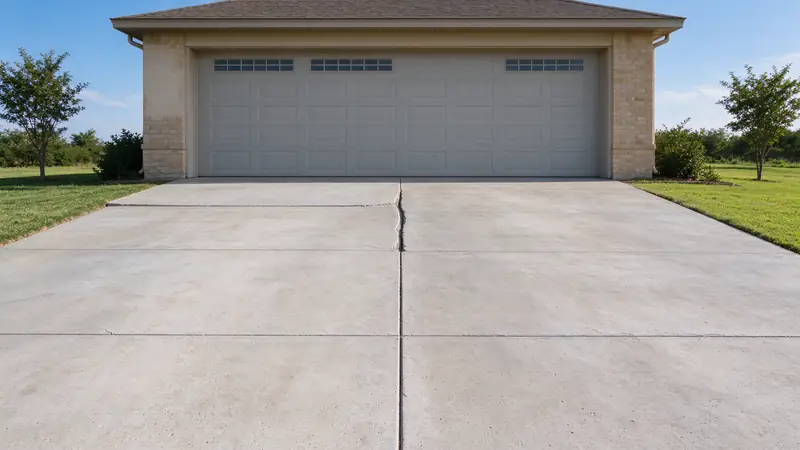
Driveways crack or sink when the pavement, its supporting base or the ground below it changes in a way the structure cannot accommodate. Some cracks are primarily surface defects; others show movement, poor support or drainage problems. In San Antonio, moisture-sensitive soils are one possible contributing factor, but no local soil map or photograph can diagnose one property's driveway. The repair depends on what failed, not just how the crack looks.
A driveway is a layered system
A concrete driveway is more than a sheet of gray material. The exposed slab carries wheel loads and distributes them into the base and soil beneath. Joints help accommodate planned movement and guide cracking. Proper drainage limits standing water and loss of support. The thickness of the slab, reinforcement details where required, preparation and compaction of the supporting ground, and expected vehicle loads all affect performance.
Asphalt uses a different pavement structure. Its wearing surface flexes more than concrete, while the aggregate base and compacted subgrade remain critical. Underloading, water intrusion, inadequate thickness, aging binder or a failing base can produce cracking, ruts and potholes. A sealer may protect a serviceable surface, but it cannot rebuild the base. That distinction is important when choosing between asphalt driveway repair and a larger driveway replacement.
The same visible symptom can arise through more than one mechanism. A long crack could reflect shrinkage, restrained movement or lost support. A low spot could be settlement of fill, erosion below a panel, or a change in the level of adjacent pavement. Good repair planning starts by separating what is visible from what remains an inference.
Why concrete driveways crack
Shrinkage and curing-related cracking
Concrete changes volume as moisture is lost and hydration progresses. Restrained shrinkage can cause cracking even when the slab has not settled. Control joints are intended to encourage cracking at planned locations, but they do not guarantee that every crack will form neatly within a joint. The crack's age, geometry, surrounding level and rate of change help determine whether cosmetic treatment is reasonable.
Freshly placed concrete also needs adequate curing and protection suited to its conditions. Hot, dry or windy weather can increase evaporation from the surface. That doesn't mean every San Antonio driveway with cracks was placed incorrectly; it means placement and curing conditions matter, particularly for new or reconstructed slabs.
Movement and loss of support
When base material is inadequately compacted, disturbed or eroded, parts of a slab may settle. Vehicle loads can then concentrate at corners, joints or weakened edges. A crack with a change in height, rocking slab, or repeated reopening deserves more attention than an isolated fine line. No filler can make loose soil beneath the slab carry a wheel load.
In some situations, individual intact slabs may be lifted to restore grade. In others, concrete has broken too severely or the supporting ground needs reconstruction. Sunken driveway repair and driveway leveling explain these different choices.
Movement at joints and adjoining structures
A garage slab, driveway panel, sidewalk and public apron may not move together. Joints are placed to separate certain elements or control shrinkage cracks. If a joint seal fails, water and debris can enter, and vegetation may establish in suitable openings. Overfilling a moving joint with a rigid product can be inappropriate. The right repair respects the joint's function and evaluates whether a change in height also needs correction.
Why San Antonio's soil and weather matter
The San Antonio region includes areas with moisture-sensitive soils. The city's hazard planning discusses expansive clay that can swell as it wets and shrink as it dries. Movement in these soils may influence paving and other structures where conditions allow it. This is a regional mechanism, not evidence that all local houses sit on expansive clay or that a specific broken slab has suffered clay-related heave.
A drought-to-rain transition can alter moisture conditions. Heavy runoff may also carry fine material from beneath an unprotected slab edge or find an existing void. On a sloping property, the direction water travels across hardscape and landscaping changes the risk of ponding near a garage or undermining a driveway margin. A visible puddle is a clue to investigate, not an automatic diagnosis of a failed drainage system.
Natural variation and construction history matter as much as the city name. Two nearby homes can have different fill depth, compaction, grading, buried utility trenches or drainage features. Even properties on the same street should not receive identical repair recommendations without considering the actual driveway.
What a sinking driveway looks like
The most obvious sign is a panel lower than its neighbor, but other symptoms can help describe the problem. A vehicle may scrape on the transition into a garage. Water may begin to collect where it formerly flowed away. The joint between panels may widen or show one side higher than the other. A slab edge may lose soil beneath it, leaving a visible unsupported lip.
A low panel does not automatically mean the entire driveway is beyond repair. If the panel remains intact and stable enough to lift, a targeted method may work. If the concrete is extensively fragmented, the base is continuing to wash out, or new grading would be impossible, partial replacement or broader reconstruction may be the better scope. The evaluation should make clear which problem the recommended work actually addresses.
Why asphalt cracks, ruts and forms potholes
Asphalt aging and repeated loads can contribute to cracking. Cracks admit water, and weak base areas may deteriorate under traffic. Distress patterns help guide inspection. Isolated longitudinal cracks do not necessarily indicate the same problem as interconnected alligator cracking. Wheel-path rutting and a pothole extending through the wearing layer also point toward a different repair than a surface opening that can be sealed.
Sealcoating can be useful maintenance for eligible asphalt surfaces, but it is not a substitute for patching or reconstruction. A surface with widespread structural cracks needs a more substantial plan. The alligator cracking guide and driveway sealcoating service clarify those distinctions.
What rainwater can do at the garage and street
Driveway grade matters because water follows the available path. If the garage is a low point or a surface has settled, runoff can collect near the building. Water moving under an unprotected edge can remove support in suitable conditions. Existing drainage structures may be clogged, too shallow, or placed where they cannot intercept the water. Some defects require only a limited pavement correction; others require a drainage component linked to the driveway.
For changes at the street edge, first determine which part is private pavement and which part is a municipal or county approach. In San Antonio, driveway approaches and curbs may involve city right-of-way permits. Bexar County separately regulates driveways accessing county-maintained roads. The City of San Antonio's permit guidance and Bexar County's right-of-way page are better starting points than assuming the rules are identical everywhere.
How to identify the problem without making it worse
Start with observations that are safe and accessible: where the crack runs, whether adjoining concrete is level, where water collects after ordinary rain, and whether the damage appears localized or widespread. Photos from a safe standing position can document the entire driveway, a close view of the defect and any adjacent garage or sidewalk transition. Do not drill, dig beneath, jack up, cut into, or test unstable pavement yourself just to obtain a diagnosis.
A licensed contractor or other qualified specialist may recommend additional assessment if concealed base conditions are unclear. A responsible estimate should name the limitations of what can be seen and describe whether further evaluation is needed before committing to a structural remedy.
Repair options from least extensive to most extensive
| Condition | Option to investigate | Important limitation |
|---|---|---|
| Stable, narrow crack | Appropriate crack filling or sealing | Does not stop continuing movement |
| Failed joint filler | Joint cleaning and replacement | Does not lift or rebuild sunken panels |
| Localized surface damage | Sound-substrate patching | Cannot bond reliably to loose concrete |
| Intact low slab | Slab lifting or leveling | Support and drainage remain important |
| Sound but worn concrete | Resurfacing or overlay | Unsuitable over unstable concrete |
| Broken panel or failed base | Partial removal and reconstruction | Requires correct support, grades and transitions |
| Widespread pavement failure | Driveway replacement | Larger scope, possible permitting and access impacts |
The point is not that every owner must choose the smallest intervention. The point is that every proposal should explain why the selected option fits the visible condition and what risks remain. When a wider driveway or different parking layout is part of the goal, that may justify replacement or extension even if some of the old surface remains serviceable.
How costs relate to failure mechanisms
Driveway repair prices follow the repair method, not the general phrase “cracked driveway.” Slab lifting with mudjacking has a typical national range of $3 to $6 per square foot lifted, and patching a spalled surface runs $3 to $4 per square foot of damaged surface as a typical national range. Neither is a San Antonio rate or an Elm price guarantee. Published figures for crack filling, foam lifting and partial panel replacement vary too widely to give a dependable range, so those jobs are priced from site conditions: crack length, width, depth and the visit minimum for crack filling; void size and foam volume for foam lifting; and the number of panels, slab thickness, base repair, reinforcement and disposal for a panel replacement. Different units, access conditions, removal work and base corrections can change a project's total substantially.
A useful driveway repair cost guide explains the national ranges and the components that influence quotes. For asphalt, gravel and commercial work, there isn't a dependable local price range, so the cost guide lists what drives the price rather than an invented estimate.
What happens during repair or replacement?
A proposed work process starts with the condition and intended use. The site is reviewed for accessible pavement damage, grades, water flow, transitions and access. The method is then selected from the options that can actually address the defect. Depending on scope, preparation may involve cleaning, saw cutting, exposing sound material, lifting or removing a slab, preparing the base, and placing new repair material.
Larger work can affect how vehicles enter or leave the property. If the project changes a public approach, the applicable approval should be resolved before work is scheduled. After completion, return-to-use instructions must match the repair product, mix and environmental conditions. The actual sequence and permit responsibilities should be made clear in the project-specific scope.
Can a driveway be maintained after repair?
Yes, maintenance may help preserve work that is otherwise sound. Keep surface drainage paths open where safe to do so, watch for a joint that loses its filler, and avoid treating recurring movement as a purely cosmetic issue. An asphalt sealcoat may be appropriate on a suitable surface, but repeated sealcoating will not restore a structurally failed base. Check repair recommendations against the pavement material, age and condition rather than following a blanket annual schedule.
For decorative concrete and pavers, use compatible materials that do not create a slick or trapped-water surface. If a repair changes the grade, observe where normal rainfall goes afterward. Any concerning reappearance of pooling, large movement or new cracking deserves reevaluation rather than simply adding another layer.
Questions homeowners commonly ask
Is a long crack always worse than several short cracks?
No. Length alone does not establish severity. Crack pattern, movement, differential elevation, support and water pathways matter more than a single measurement.
Can I seal a crack and then resurface the driveway?
Only if the underlying concrete is suitable for the selected overlay. Resurfacing an actively moving or delaminated slab can fail even when the initial finish looks good.
Is every sunken slab caused by clay soil?
No. Inadequate compaction, erosion, disturbed fill and other conditions can produce settlement. Soil movement is one possibility in the region, but a diagnosis depends on the particular site.
When should I consider full driveway replacement?
When the extent of damage, poor base support, incompatible grades or intended layout make repeated local repair impractical. An intact, isolated panel should not trigger automatic wholesale replacement.
Plan the next step
Elm Driveway Repair San Antonio covers concrete and asphalt driveway repair, leveling, replacement, and related commercial paving services throughout San Antonio and its nearby communities. Review concrete driveway repair, sunken driveway repair or driveway drainage for a specific problem, then use the estimate form below to describe what is happening on the property. The goal is to narrow the work to what the condition actually supports.