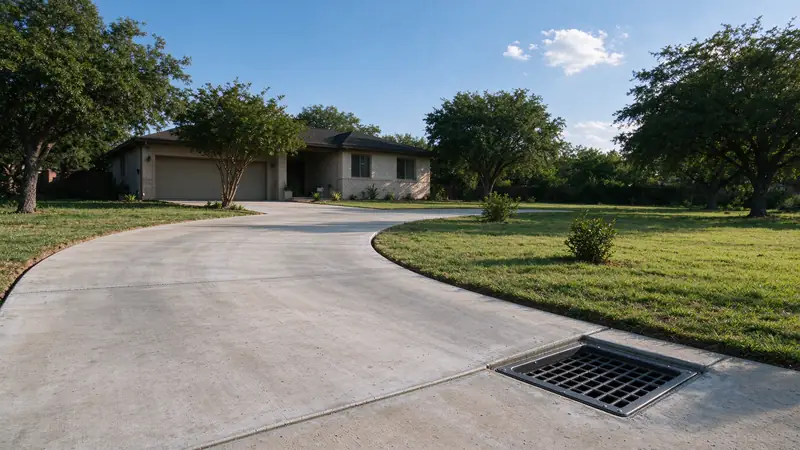
Leon Valley’s street and public-works information adds a useful drainage dimension to driveway repair. Some sloping properties and alley conditions require attention to how water moves beyond the pavement, not just how a repaired slab looks.
Identify the water route before resurfacing
A low driveway at the garage may collect runoff from the street, roof drainage or an adjacent slope. An overlay can raise a section and move the ponding somewhere else without solving the underlying issue. The first step is to observe the actual drainage direction and identify a legitimate outlet. Leon Valley’s public-works descriptions recognize sloped areas and alleys serving drainage functions; that does not mean every property is affected. For a specific lot, ask how the proposed grade relates to the alley, curb, garage and neighboring land. Avoid any plan that simply directs stormwater off the property without considering where it goes.
Residential and commercial access are distinct scopes
Leon Valley publishes driveway and access standards applicable to different property types. A family driveway with a cracked apron may need a limited street-side reconstruction, while a commercial entrance used by delivery vehicles may require thicker structural repair and traffic access planning. The road jurisdiction and proposed use determine the applicable procedure. For a new curb cut or widened approach, first confirm the regulated access geometry. For an existing asphalt patch inside a parking area, the work method and permit question may be different. A single quote label such as driveway repair should not blur those choices.
Deciding whether a concrete slab can stay
An isolated stable crack does not necessarily justify demolition. Where concrete is intact but lower than adjacent pavement, leveling may be considered if the support condition and resulting grade are suitable. If the slab is broken or the soil has eroded, lifting alone may not restore the required structure. Watch for a sharp change in height where a vehicle crosses the sidewalk or enters a garage. A cosmetic skim coat can make that transition worse. The proper estimate should state whether removal, base correction, joint work or drainage changes are part of the scope.
Keep drainage and permitting visible in the estimate
Ask how the finished pavement will shed water, whether the project changes an alley or public approach and which local standards apply. A quote should separate repair quantities from permit administration and explain whether nearby landscaping or drains must be restored. Photos taken during dry weather and after a rain can help establish the water path without hazardous testing. Different driveway materials also have different return-to-service restrictions; avoid a guaranteed schedule before the material and work conditions are known. A property-specific assessment is still essential because citywide terrain descriptions cannot diagnose one driveway.
Leon Valley driveway questions
Does every Leon Valley driveway have an alley drainage issue?
No. The city describes such conditions in public works, but the actual property and runoff path must be checked.
Can sealcoating make a sunken driveway drain correctly?
No. Sealcoating does not change the underlying pavement structure or correct major elevations.
Why does commercial access affect repair planning?
Traffic loading, pedestrian movement, closure planning and local access rules can differ from an ordinary residential driveway.
Additional planning considerations
Water can make a repair proposal sound simpler than it is. If the driveway sits lower than the street, a coating will not change that elevation. A channel drain might capture runoff, but it needs a legal outlet and enough slope to function. If the property backs onto an alley that conveys drainage, the contractor must not redirect water casually into it. The local public-works context makes the water path a real project question, not a marketing adjective. A homeowner can document where water collects, then ask how each proposed method changes the finished grade.
For a business driveway, the same pavement damage may matter differently because delivery vehicles turn repeatedly at the entrance. An isolated surface patch could be appropriate when support remains firm, but repeated rutting or fatigue cracking may require full-depth work. If pavement is reconstructed near a public road, the access standard and work-zone plan need to be addressed. A striping project may also require accessibility-layout consideration even when it is not rebuilding the asphalt. Separating traffic use, structural repair and visual maintenance helps the property manager choose a meaningful scope rather than buying the least expensive-looking finish.
A scope check before scheduling
The same visible depression can call for two different remedies depending on where the water comes from. If the slab itself has settled, an intact panel may be evaluated for lifting. If the driveway slopes toward a garage because of its overall geometry, lifting one isolated spot may not solve the route of runoff. A drain could be considered only with a workable and lawful outlet. When a property connects to an alley or public street, the project should not presume a right to redirect flow there. Asking about the outlet early prevents an attractive but ineffective finished surface.
Related services and local references
Concrete driveway repair · Asphalt driveway repair · Driveway replacement · Driveway drainage · Service areas.
Elm Driveway Repair San Antonio coordinates driveway and pavement service in the service area with work performed by appropriately licensed and insured contractors. The condition must be evaluated before choosing a repair technique or making a scheduling commitment. For a property-specific proposal, send the surface description and photos.
Official starting points: