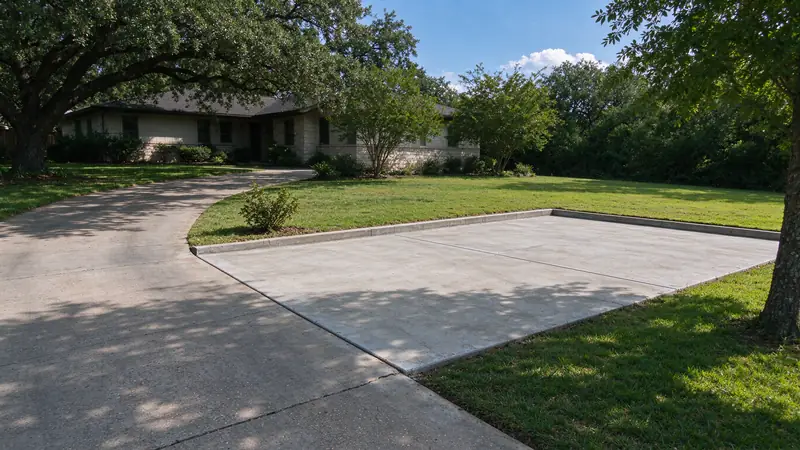
Live Oak specifically includes driveways and parking pads in its local construction guidance. That makes RV parking and extra vehicle spaces an important planning question alongside ordinary slab repairs, especially when work approaches the street or an underground utility.
Parking-pad construction begins with vehicle use
An owner adding space for an RV, boat or trailer needs to know the vehicle dimensions, turning path, axle loading and the location where parking is permitted. A surface intended for passenger cars may not be suitable for concentrated heavier loads without checking its pavement section and support. The proposed pad should also drain without pushing water toward a neighbor, garage or public walkway. The city’s parking-pad requirements are separate from general advice about how to repair a crack. Before the footprint is finalized, verify local restrictions and any applicable subdivision rules.
Locating buried services takes more than guessing
Driveway removal and new pavement may disturb soil near water, drainage, communications or other utilities. Live Oak publishes guidance on utility locating and city-related infrastructure in addition to the statewide Texas 811 process. A homeowner should not assume that every private or municipal line has been located simply because one marking request was made. The contractor should identify what work will disturb the ground, what locating process applies and whether access or inspection coordination is required. This is especially relevant when extending a driveway into a previously unpaved area or creating a new drainage connection.
Different problems call for different paving methods
A stable concrete surface defect may be repaired locally, while a panel that settles at the street requires evaluation of support and public approach grade. Asphalt sealcoating can help maintain a suitable wearing surface, but cannot rebuild a pothole. Gravel washouts may require base compaction and a corrected water path. For a new parking pad, thickness and base preparation must be matched to expected loading. None of these decisions follows automatically from the word driveway. A quote should name the exact material and operation being proposed and explain why it fits the observed condition.
Ask what local approval and access involve
The permit answer should be determined for the specific Live Oak address and activity, including whether the work remains on private land or reaches the public curb. Photograph the existing entrance and any part of the proposed extension. A written proposal should distinguish the concrete or asphalt work from utility locating, permits, grading and restoration of adjacent landscaping. If a heavy vehicle will use the new surface, that should be disclosed during design, not discovered after pouring. Avoid promising that an approved paved pad by itself establishes the right to park a particular vehicle there.
Live Oak driveway questions
Does Live Oak list parking pads in its rules?
Yes, the city publishes requirements covering driveways and parking pads; the exact approval depends on the proposed work.
Is Texas 811 sufficient for every underground line?
Not necessarily. Follow state locating procedures and check the city’s guidance for other applicable utilities.
Can a standard driveway slab automatically support an RV?
No assumption is safe. Design should account for vehicle loading, subgrade, pavement thickness and access geometry.
Additional planning considerations
Parking-pad work calls for different facts than an ordinary crack repair. Record the actual RV or trailer dimensions, whether it has stabilizing jacks, how it will enter the pad and whether the intended location is allowed. A smooth slab can still be unsuitable if the base and thickness were not designed for the load. Grades matter because a heavy vehicle can struggle with a sharp transition at a curb or driveway joint. The public approval question should be addressed before building the pad, and that approval should not be described as permission to ignore separate parking restrictions.
Utility locating is another reason to identify the scope before excavation. An isolated surface repair may disturb little soil, while extending pavement onto a previously landscaped strip may require deeper preparation or drainage work. The responsible contractor should coordinate the applicable locate process and confirm which services are covered by it. Do not assume a green lawn contains no underground lines. A realistic estimate should reflect the difference between placing a finish over existing stable pavement and creating a new structural paved area with excavation, base compaction and access checks.
A scope check before scheduling
For a new parking pad, record the heavy vehicle’s actual turning route rather than relying only on its parked dimensions. A long vehicle may need additional clearance at the driveway entrance and a gradual transition to reach a side-yard pad. Paving over landscaping may involve excavation, and that is where utility locating becomes especially important. The contractor should not assume every buried service is covered by a single notice. The proposal can name what must be verified before digging, while preserving the distinction between a residential driveway repair and a newly constructed vehicle-rated surface.
Related services and local references
Concrete driveway repair · Asphalt driveway repair · Driveway replacement · Driveway drainage · Service areas.
Elm Driveway Repair San Antonio coordinates driveway and pavement service in the service area with work performed by appropriately licensed and insured contractors. The condition must be evaluated before choosing a repair technique or making a scheduling commitment. For a property-specific proposal, send the surface description and photos.
Official starting points: